Tuesday, 6 December 2016

Global Colocation Market Attains Maturity

Today, cost is major motivating factor when business owners approach a colocation provider. Likewise, the budgetary benefits of these strategies are only growing. Furthermore, a study carried out by “Infiniti Research” indicated that the colocation segment in the North America would grow at an annual rate of nearly 13.36 % during the forecast period of 2012 – 2016. While the “TeleGeography” ranks international operators in the colocation space, it confirms that competition level in the colocation industry differs majorly in terms of region and maturity level. In recent times, the aforementioned industry grows with reputed business leaders participating in mergers, acquisitions and collaborations.

Get a detailed Research in Colocation Industry at: https://www.alliedmarketresearch.com/colocation-market

Colocation Market: AMR


According to an article published in the “Data Centre Knowledge “the key market player “Equinix” reserves nearly 10 percent of the colocation segment , is planning on acquiring “TelecityGroup”. Moreover, there are assumptions that “Digital Reality”, second largest operator in the aforesaid segment will soon acquire Telx. The acquisition would not on only encourage consolidation but also an entry into the retail colocation market for Digital, popular in the wholesale data centre operator.  Besides this, colocation providers are also seen upgrading their existing their data centre offerings.

365 Data Centers disclosed that it has upgraded its data centres, to ensure speedy delivery, minimum latency and lower distribution cost of the content. Demand for rich content has triggered growth in the video and media industry worldwide. The CEO at 365 Data Centers, John Scanlon said “Each of these transactions furthers our commitment to facilitate the move of content and cloud services closer to the edge, which significantly improves the user experience. Our facilities offer a rich fabric of interconnection options to multiple distribution networks and are professionally managed to deliver 100 percent uptime. We will continue investing in strategic markets where we enjoy a competitive advantage and where the market is growing rapidly. In most cases, that means emerging Tier 2 cities in the U.S.,”

Apart from this Frost & Sullivan predicts that revenue for the colocation industry in United States would increase by 12 percent annually in 2017. Simultaneously, several colocation market operators are observing data center as their non-core functions best suited for enterprises specializing – thus increasing the demand of the colocation services. According to a report published by “Allied Market Research” titled “Global Colocation - Market Opportunities and Forecasts, 2014 – 2020” the colocation segment would see a CAGR of 9.1 percent during the forecast period 2015 to 2020. 


Tuesday, 15 November 2016

Agriculture technology innovation, education bring farming into the future


Salinas, on the central coast of California, is agriculture country. It’s even known for being the birthplace of author John Steinbeck whose Pulitzer-prize winning novel “The Grapes of Wrath” is about the plight of farmers during the Great Depression. But Salinas is also embracing the future and looking toward tech to take it there.

In Salinas, Carson Britz, the son of a farmer, brainstorms how sprinkler piping can become part of the shared economy.

Philippine agriculture, farming to benefit from innovative tech


MANILA, Philippines – There are a lot more opportunities to use technology to improve Philippine agriculture and farming, according to digital enterprise transformation consultant Winston Damarillo.

Damarillo, executive chairman of consulting firm Amihan Global Strategies (AGSX), said there is a lot more energy in the Global Shapers, the young version of the World Economic Forum, where many of the members are farmers.

Wednesday, 12 October 2016

Colocation: Make the Future of IT a Reality

The movement to colocation-or colo-is accelerating and will have profound implications for enterprises and service providers. Colocation involves renting space in a third-party data center and can also include a mix of hardware, software, and services. The tactic is surging at a 16% compound annual growth rate through 2020, from $25.70 billion in 2015 to $54.13. By 2018, 65% of companies’ IT assets will be off-site in colocation, hosting, and cloud data centers, according to IDC, while 33% of IT “staff” will be employees of third-party service providers.

“Colocation continues to be the bedrock for much of Cloud 2.0,” says Katie Broderick, research director, 451 Research. “The global colocation market is the physical (facilities and networking) underpinning of both enterprises’ off-premises computing, as well as hosting and cloud service providers’ value-add services.”

A big reason for colocation’s success is the opportunity to shift from a pricey CapEx (capital expense) budget line item to a much less expensive OpEx (operating expense) model. However there are a number of other benefits—and implications—to consider before going colo.

Top considerations when deciding to go colo—and picking the right partner—include location, pricing, security, and offerings. Location is key, because the facility has to be easily accessible by your IT staff, close to a power source, and should be in a safe area—i.e. hurricane belts, flood plains, and earthquake zones should be avoided.

Pricing is important because colo users are typically looking to lower their costs and make them more manageable from a budgeting perspective, i.e. usage-based pricing and monthly fees. Other factors that come into play include real estate, power, redundancy, and risk mitigation costs.

Read More@ http://www.cio.com/article/3087609/cloud-computing/colocation-make-the-future-of-it-a-reality.html

Google Exec Confirms Plans to Bring Voice Assistant to Third-Party Home Audio Hardware

Google’s Assistant won’t be limited to Google-made devices for long: The company is having conversations with home audio equipment makers to add the voice-powered assistant to third-party hardware, confirmed Google’s consumer hardware VP of product management Mario Queiroz Tuesday.

Queiroz made the comments on the sidelines of Google’s fall hardware event in San Francisco, where the company officially introduced its new Google Home smart speaker. Google Home is a bit like Google’s version of Amazon’s Echo speaker; the device allows consumers to launch music playback, ask for news and weather reports, query their calendar or even add items to their shopping list, all with simple voice commands.

Thursday, 6 October 2016

Apple says new wireless technology is better than Bluetooth

Now that Apple has pronounced the end of the headphone jack, the company is aiming to prove that it can do better than the existing wireless options.

At its much-hyped event in San Francisco on Wednesday, the iPhone maker introduced a cordless earbud that it claims is more power efficient than Bluetooth devices. AirPods, as they're called, have their own communications chip, Apple's Senior Vice President Phil Schiller said on stage.

"It makes no sense to tether ourselves with cables to our mobile devices," Schiller said. "Until someone takes on these challenges, that's what we'll do."

The iPhone 7 will be the first smartphone without a headphone jack, marking Apple's latest effort to strip hardware from devices. There are plenty of Bluetooth options on the market, including from Apple's Beats business, but the products have been criticized for their high price and spotty quality.

Apple’s AirPods do use Bluetooth and they don’t require an iPhone 7

When Apple introduced its AirPods on Wednesday, the company went on and on about the new Apple-made chip on the inside, but said little about the technology that delivers the sound to the wireless earbuds from the iPhone.


It turns out Apple isn’t using some Bluetooth-like wireless technology, as rumors suggested, but rather Bluetooth itself.

Apple, Google remain most valuable brands

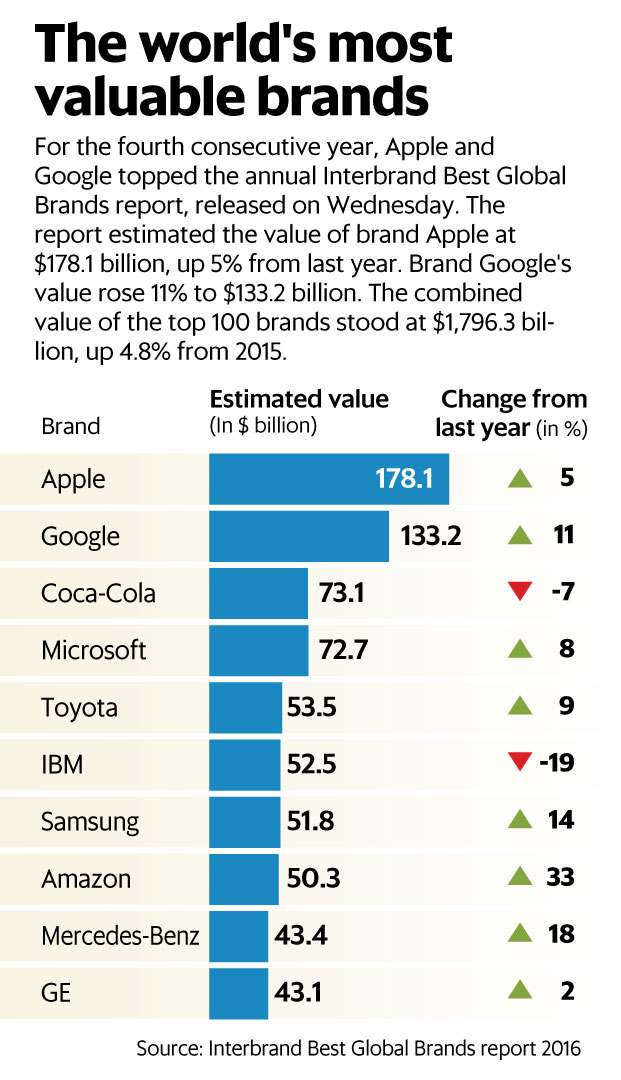
New Delhi: Silicon Valley is home to the two most valuable brands in the world. For the fourth consecutive year, Apple and Google topped the annual Interbrand Best Global Brands Report, released Wednesday.

The report estimated the value of brand Apple at $178.1 billion, up 5% from last year. Value of brand Google was estimated at $133.2 billion, an increase of 11% from last year.

Beverages brand Coca-Cola stood third in the list at an estimated brand value of $73.1 billion, a 7% dip in brand value from last year. The top 10 brands in the list included Microsoft, Toyota, IBM, Samsung, Amazon, Mercedes-Benz and GE.

According to the list by the global brand consultancy, the world’s five top growing brands included Facebook, Amazon, LEGO, Nissan and Adobe. Brand Facebook witnessed the maximum increase in value at $32.5 billion, an increase of 48%, followed by Amazon.com (33%), LEGO (25%), Nissan (22%) and Adobe (21%), according to the report.

Google’s Self-Driving Cars Have More Driving Experience Than Any Human

Seven years ago, Google started a project to pursue a futuristic idea: Develop cars with software so advanced that it could take over all the driving for humans. Today, not only are Google’s fleet of self-driving cars navigating complex conditions in four U.S. cities, an entire industry has exploded with startups and automakers clamoring to develop the same technology.

“In 2009 we were just this crazy research project working on a science fiction idea,” Dmitri Dolgov, head of Google’s self-driving technology, told Fortune. “And look at where we are today. ”

Google self-driving cars have logged 2 million fully-autonomous miles on public roads, 90% of which were on city streets, the company announced Wednesday. Considering the hours spent on the road, Google’s cars now have the equivalent of 300 years of human driving experience.

Wednesday, 28 September 2016

Text analytics and beyondText analytics and beyond

The term “text analytics” encompasses a broad and heterogeneous group of technologies that can add metadata to unstructured content; identify components such as people, places and events; and convert information to structured form so it can be analyzed by business intelligence (BI) solutions. The technology may employ statistical, linguistic and machine learning approaches to extract meaningful information. It can be used in a wide range of business purposes, from fraud detection to sentiment analysis. The push is increasingly toward more sophisticated interpretation of unstructured content that goes beyond what is currently considered text analytics.

According to Forrester, more than 200 companies are providing text mining or text analytics products, so it is a crowded market. The participating software products offer a variety of approaches to extracting actionable information from content that is generally recognized as accounting for about 80 percent of enterprise content. Those software solutions are becoming more intelligent. Rather than focusing on keyword searches or statistical analyses alone, they are incorporating a deeper understanding of language through greater semantic analysis and machine learning. That trend is moving text analytics well past the traditional approaches into the realm of cognitive computing. 

Broadening the Scope of Mobile Security

Most enterprises, when addressing mobile security, focus on securing applications, such as the devices' operating systems, or preventing the installation of malware. But the cybersecurity experts at the National Institute of Standards and Technology say organizations should take a much broader approach to ensuring mobile security.

Referring to the need to address the risks posed by cellular networks and other elements of the mobile infrastructure, NIST Cybersecurity Engineer Joshua Franklin says: "There is this whole other side of a mobile device that has its own complex hardware, firmware, software and network protocols that need to be addressed." Franklin co-authored the recently released draft report, Assessing Threats to Mobile Devices & Infrastructure: the Mobile Threat Catalogue.

Monday, 26 September 2016

US Data Center Construction Update

September turned out to be a big month for big data center construction project announcements in the US. Facebook has finally decided to build in New Mexico, SAP is stepping into Colorado Springs in a big way, and data center providers Data Foundry and TierPoint are expanding their empires in Texas.

Here are the details:

New Mexico Scores $250M Facebook Data Center Build

After a tax-break war with the State of Utah, New Mexico has secured a commitment from Facebook to build its next data center in the Village of Los Lunas.

Thursday, 22 September 2016

Is Infor up for sale?


Over the last few weeks investment in ERP software has been increasing. The latest rumour (Source:Reuters) is that Infor is the latest in a line of companies sold or resold. It seems like private equity firms believe that there is money to be made in ERP software. According to Allied market Research the global ERP software market is set to grow 7.2% each year until 2020 when it will reach $41.69 billion.

The last year has seen several deals commence that should complete before the end of 2016. In December 2016 EQT made a bid for IFS, the Swedish ERP software company. While the initial bid saw only 84% snapped up, a revised offer was recently agreed with the hold out investor. This should see IFS taken private within a matter of weeks. Oracle made a bid for NetSuite, valuing the company at $9.3 billion in July. That purchase has since been delayed with one investor, T Rowe Price group saying that the bid is not high enough. In July this year Apax partners sold Epicor to KKR in a deal said to be worth $3.3 billion (Source: Bloomberg).

Wednesday, 21 September 2016

Official: Cloud computing is now mainstream

Cloud computing is so mainstream these days that maybe it should just be called “computing”. That’s what an IDC survey of 6,100 organisations in 31 countries, released today, indicates, with 68 per cent of respondents using public, private or hybrid cloud in their IT mix. This is a 60 per cent jump from 42 per cent of respondents doing cloud in 2015.

IDC reckons that just three per cent of the organisations have deploying cloud-optimised strategies resulting in "superior business outcomes".

And of this select “cloud-advanced” bunch, Ninety-five per cent have built a hybrid infrastructure that uses “multiple private and public clouds based on economics, location and governance policies”.

Monday, 19 September 2016

Gamification of the aviation sector

Restructuring IT systems in the aviation sector requires cross-disciplinary collaboration between experts from different organisations and countries. This isn't easy. Can help be found in the world of computer games?

The use of games mechanics for purposes other than pure entertainment is called gamification. In recent years the method has been used in different settings to boost user involvement and motivation linked to a variety of activities.
"In its simplest form this may just be hype, such as awarding points for things like filling out your time sheet before the weekend," says SINTEF researcher Erlend Andreas Gjære. "But our focus is on quite a different track," he says.
Together with researchers from Italy and Germany, Gjære and his colleagues at SINTEF are going to find out how aspects of games technology can be applied in a context somewhat out of the ordinary. Specifically – how to achieve the best possible adaptive solutions to changes in information security, safety, economics and organisation in the aviation sector.

Sunday, 18 September 2016

Big data analytics and NLP: How health plans can make more money -- and keep it

Natural language processing is an emerging area that can help unlock value from the vast stores of unstructured data that account for as much as 80% of all clinical data. UPMC Health Plan does just that.

Big data analytics in healthcare has largely been about looking at claims, electronic health records (EHR) and other forms of structured data. Natural language processing (NLP) is an emerging area that can help unlock value from the vast amounts of unstructured data that are pervasive in healthcare. In the emerging era of value-based payments, risk adjustments may well determine the difference between profit and loss for the health insurance industry.

UPMC Health Plan, the health insurance arm of the University of Pittsburgh Medical Center (UPMC), has deployed NLP-based technology and big data analytics to efficiently process millions of pieces of documentation to accurately identify risk adjustment possibilities and capture incremental revenue.

Thursday, 15 September 2016

GERMANY PLANS FACIAL RECOGNITION AT AIRPORTS AND TRAIN STATIONS

Germany is planning to introduce facial recognition software to cameras at transport hubs as part of new anti-terrorism measures, the country’s interior minister has announced.

Thomas de Maiziere told German newspaper Bild am Sonntag that the technology would be able to identify suspects following two attacks by Islamist militants in the past month.

“I would like to use this kind of facial recognition technology in video cameras at airports and train stations,” de Maiziere told the paper. “Then, if a suspect appears and is recognized it will show up in the system.”

Try Newsweek for only $1.25 per week

De Maiziere also suggested other security measures were being considered, adding: “We will have to get used to increased security measures, such as longer queues, stricter checks or personal entry cards. This is tedious, uncomfortable and costs time but I don’t think it’s a limitation of personal freedom.”

German Chancellor Angela Merkel has been under increased political pressure to introduce stricter measures since the recent attacks, however, privacy advocates have criticized proposals for increased surveillance.

A spokesperson for Germany’s Green Party told DPA news agency that the plan was “half-baked.”

Read More@ http://www.newsweek.com/germany-plans-facial-recognition-airports-train-stations-security-attack-492740

Facial recognition - a powerful ad tool or privacy nightmare?

Whenever the future of advertising is discussed, thoughts often turn to the sci-fi image of a stalked Tom Cruise in Minority Report being recognised and served intrusive, personalised advertising as he tries to escape a futuristic city.

Hence, recent claims by Russian app FindFace that it could identify people in public by their profile picture on a Russian social media site were met with a combination of awe and concern. Such facial recognition could enable digital screens to tailor messages to each individual as they pass, meaning an end to brands wasting budget advertising the wrong products to the wrong people.

Monday, 29 August 2016

Bullish Forecast for Hadoop Services

Despite major market inroads being made by Apache Spark, a new forecast estimates the global market for the Hadoop big data framework will continue to grow at a healthy clip through 2021, fueled in part by growing enterprise demand for Hadoop services.

According to a market forecast released this week by Allied Market Research, the Hadoop market is expected to grow at a 63.4 percent compound annual growth rate over the next five years, reaching $84.6 billion by 2021. The sustained growth is attributed in part to accelerated Hadoop adoption in Europe, where annual growth rates are expected to top 65 percent.

The sustained growth of the Hadoop market stems largely from higher rates of adoption in North America, especially in the IT, banking and government sectors as enterprise big data strategies have been rolled out.

Bullish Hadoop Forecast Despite Spark Hype


Despite major market inroads being made by Apache Spark, a new forecast estimates the global market for the Hadoop big data framework will continue to grow at a healthy clip through 2021, fueled in part by growing enterprise demand for Hadoop services.