Showing posts with label Technology. Show all posts

Tuesday, 15 November 2016

Agriculture technology innovation, education bring farming into the future


Salinas, on the central coast of California, is agriculture country. It’s even known for being the birthplace of author John Steinbeck whose Pulitzer-prize winning novel “The Grapes of Wrath” is about the plight of farmers during the Great Depression. But Salinas is also embracing the future and looking toward tech to take it there.

In Salinas, Carson Britz, the son of a farmer, brainstorms how sprinkler piping can become part of the shared economy.

Thursday, 6 October 2016

Apple, Google remain most valuable brands

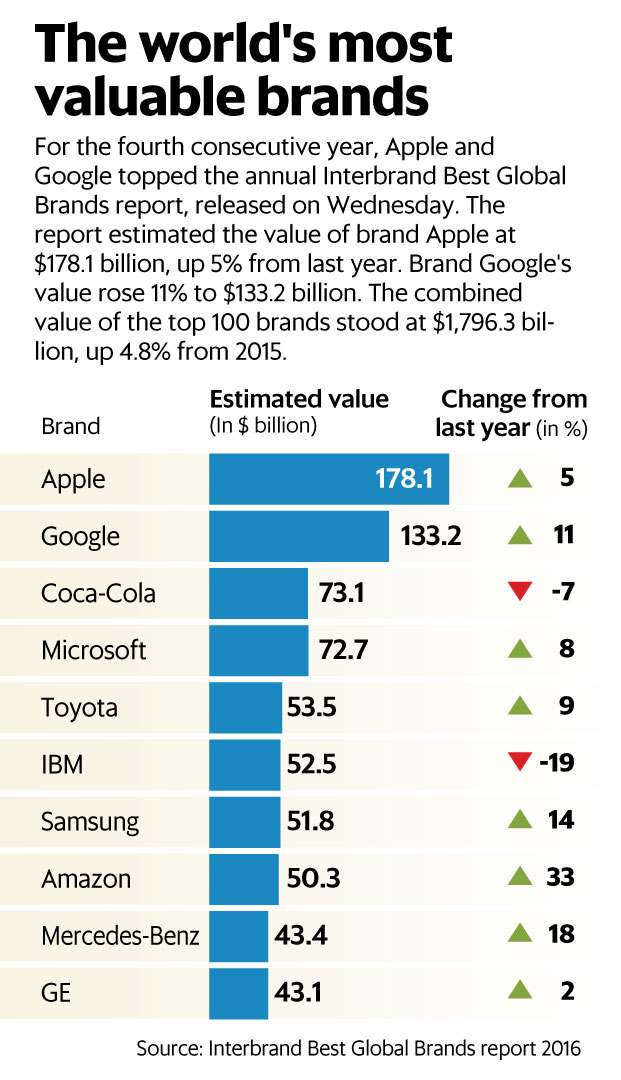
New Delhi: Silicon Valley is home to the two most valuable brands in the world. For the fourth consecutive year, Apple and Google topped the annual Interbrand Best Global Brands Report, released Wednesday.

The report estimated the value of brand Apple at $178.1 billion, up 5% from last year. Value of brand Google was estimated at $133.2 billion, an increase of 11% from last year.

Beverages brand Coca-Cola stood third in the list at an estimated brand value of $73.1 billion, a 7% dip in brand value from last year. The top 10 brands in the list included Microsoft, Toyota, IBM, Samsung, Amazon, Mercedes-Benz and GE.

According to the list by the global brand consultancy, the world’s five top growing brands included Facebook, Amazon, LEGO, Nissan and Adobe. Brand Facebook witnessed the maximum increase in value at $32.5 billion, an increase of 48%, followed by Amazon.com (33%), LEGO (25%), Nissan (22%) and Adobe (21%), according to the report.

Google’s Self-Driving Cars Have More Driving Experience Than Any Human

Seven years ago, Google started a project to pursue a futuristic idea: Develop cars with software so advanced that it could take over all the driving for humans. Today, not only are Google’s fleet of self-driving cars navigating complex conditions in four U.S. cities, an entire industry has exploded with startups and automakers clamoring to develop the same technology.

“In 2009 we were just this crazy research project working on a science fiction idea,” Dmitri Dolgov, head of Google’s self-driving technology, told Fortune. “And look at where we are today. ”

Google self-driving cars have logged 2 million fully-autonomous miles on public roads, 90% of which were on city streets, the company announced Wednesday. Considering the hours spent on the road, Google’s cars now have the equivalent of 300 years of human driving experience.

Wednesday, 28 September 2016

Broadening the Scope of Mobile Security

Most enterprises, when addressing mobile security, focus on securing applications, such as the devices' operating systems, or preventing the installation of malware. But the cybersecurity experts at the National Institute of Standards and Technology say organizations should take a much broader approach to ensuring mobile security.

Referring to the need to address the risks posed by cellular networks and other elements of the mobile infrastructure, NIST Cybersecurity Engineer Joshua Franklin says: "There is this whole other side of a mobile device that has its own complex hardware, firmware, software and network protocols that need to be addressed." Franklin co-authored the recently released draft report, Assessing Threats to Mobile Devices & Infrastructure: the Mobile Threat Catalogue.

Thursday, 15 September 2016

GERMANY PLANS FACIAL RECOGNITION AT AIRPORTS AND TRAIN STATIONS

Germany is planning to introduce facial recognition software to cameras at transport hubs as part of new anti-terrorism measures, the country’s interior minister has announced.

Thomas de Maiziere told German newspaper Bild am Sonntag that the technology would be able to identify suspects following two attacks by Islamist militants in the past month.

“I would like to use this kind of facial recognition technology in video cameras at airports and train stations,” de Maiziere told the paper. “Then, if a suspect appears and is recognized it will show up in the system.”

Try Newsweek for only $1.25 per week

De Maiziere also suggested other security measures were being considered, adding: “We will have to get used to increased security measures, such as longer queues, stricter checks or personal entry cards. This is tedious, uncomfortable and costs time but I don’t think it’s a limitation of personal freedom.”

German Chancellor Angela Merkel has been under increased political pressure to introduce stricter measures since the recent attacks, however, privacy advocates have criticized proposals for increased surveillance.

A spokesperson for Germany’s Green Party told DPA news agency that the plan was “half-baked.”

Read More@ http://www.newsweek.com/germany-plans-facial-recognition-airports-train-stations-security-attack-492740

Monday, 29 August 2016

Bullish Forecast for Hadoop Services

Despite major market inroads being made by Apache Spark, a new forecast estimates the global market for the Hadoop big data framework will continue to grow at a healthy clip through 2021, fueled in part by growing enterprise demand for Hadoop services.

According to a market forecast released this week by Allied Market Research, the Hadoop market is expected to grow at a 63.4 percent compound annual growth rate over the next five years, reaching $84.6 billion by 2021. The sustained growth is attributed in part to accelerated Hadoop adoption in Europe, where annual growth rates are expected to top 65 percent.

The sustained growth of the Hadoop market stems largely from higher rates of adoption in North America, especially in the IT, banking and government sectors as enterprise big data strategies have been rolled out.

Monday, 8 August 2016

Rio Olympics 2016: Medal hopes ride on technology

RIO DE JANEIRO: The seeds for many of the 25, maybe 30, medals the US track team hopes to win in Rio de Janeiro were planted at a training center in California with the help of technology originally designed for golf.

One of the many tools USA Track and Field makes available to its athletes is called "Track Man," a computerized tracking device that sports fans might recognize from watching golf on TV . In addition to golf balls, "Track Man" can trace the trajectory of shot puts and hammers to allow the athletes who throw them keep track of how high and far they go.

"Immediate feedback," says Phil Cheetham, senior sport technologist for the US Olympic Committee, when asked about the greatest benefit of the technology. "Immediate knowledge of results is proven to help you improve technique much more quickly than if you don't have the feedback."

Saddled with restrictive sponsorship rules and less-than-ideal earning potential, athletes have been lashing out for years against organizations such as the USATF for not plowing their profits back into the pockets of the people who put on the show.

Track Man and the program at the Olympic Training Center in Chula Vista, California, are examples of how the federations are, indeed, trying to invest in athletes. Some of the investment comes in the form of direct cash into the pockets of the runners and throwers; other comes in training tools like Track Man and similar technologies that help sprinters and jumpers.

"Since I got here, I've improved over four feet," said Joe Kovacs, the 2015 world champion whose first coach was his mother. "It's been a combination of great coaching, awesome facilities and the technology we have."

Most notable among those who don't think USATF does all it can for athletes is 800-meter runner Nick Symmonds, who boycotted world championships last year over a dispute about what runners can wear in a sport where both athletes and institutions depend on shoe and apparel companies for most of their money. Symmonds was injured and didn't qualify for the Olympics, but he's hardly alone.

Read More@ http://timesofindia.indiatimes.com/tech/tech-news/Rio-Olympics-2016-Medal-hopes-ride-on-technology/articleshow/53596891.cms

Wednesday, 27 July 2016

Snapchat Suit May Influence Facial Recognition Technology Controversy

The lawsuit against Snapchat brought by two Illinois residents is making its way to federal court in California-and eventually may help address controversies about the use of facial recognition technology.

The lawsuit focuses on Snapchat’s “Lenses” feature and whether it conflicts with the Illinois Biometric Information Privacy Act (BIPA). The plaintiffs say it does, but Snapchat contends it recognizes objects, not “a specific face.”

“Snapchat’s proprietary facial recognition technology scans a user’s face each time he or she uses Lenses to send a snap or story and collects, stores and uses geometric data relating to the unique points and contours (i.e. biometric identifiers of each face),” the lawsuit filed initially in Los Angeles Superior Court said.

Under BIPA, Snapchat or another company cannot obtain someone’s biometrics unless it informs the person in writing; receives a written release from the person who provides informed consent; and publishes guidelines for destroying biometric identifiers, with these guidelines being available to the public, according to the lawsuit.

But Snapchat never informed its users in Illinois about “the specific purpose and length of term for which their biometric identifiers or information would be collected, stored or used,” the lawsuit contends. Snapchat also did not get a written release or consent from these users, nor did the company have publically available guidelines on when the identifiers would be destroyed, the lawsuit adds.

It further claims that Snapchat has created, collected and stored tens of millions and maybe hundreds of millions of face templates, as it estimates that tens of thousands of Snapchat users live in Illinois. Snapchat creates the templates using “sophisticated facial recognition technology” that can extract and analyze data from the “points and contours of users’ faces when they use Snapchat’s Lenses feature,” according to the lawsuit.

Read More@http://www.law.com/sites/articles/2016/07/26/snapchat-suit-may-influence-facial-recognition-technology-controversy/?slreturn=20160627082736

Thursday, 30 June 2016

Data Center SDN: Comparing VMware NSX, Cisco ACI, and Open SDN Options

The data center network layer is the engine that manages some of the most important business data points you have. Applications, users, specific services, and even entire business segments are all tied to network capabilities and delivery architectures. And with all the growth around cloud, virtualization, and the digital workspace, the network layer has become even more imporant.

Most of all, we’re seeing more intelligence and integration taking place at the network layer. The biggest evolution in networking includes integration with other services, the integration of cloud, and network virtualization. Let’s pause there and take a brief look at that last concept.

Thursday, 16 June 2016

SDN is Coming. Is Your Workforce Ready?

SDN is moving into the data center at a rapid clip, but while deploying a new technology is one thing, getting people to use it properly is quite another.

According to market analyst IHS Inc., SDN revenues grew more than 80 percent in 2015 compared to the year earlier, topping $1.4 billion. The bulk of that came in the form of new Ethernet switches and controllers, although newer use cases like SD-WAN are on the rise as well and will likely contribute substantially to the overall market by the end of the decade.

This means that, ready or not, the enterprise network is quickly becoming virtualized, severing the last link between data architectures and underlying hardware. This will do wonders for network flexibility and scalability, but it also produces a radically new environment for network managers, few of whom have gotten the appropriate levels of training, if anecdotal evidence is any indication.

Monday, 13 June 2016

DATA CENTERS: MAKING THE BUSINESS AND CONSUMER WORLDS GO ’ROUND

Today, a connection to the Internet is absolutely critical. Many activities require network support, from checking social media and sending emails to video conferencing with colleagues and accessing an employer’s online tools. Each time you take part in processes like these, you’re using a data center to do so.

Friday, 3 June 2016

The Future Of Situational Awareness


The Defense Advanced Research Projects Agency, or DARPA, has kicked off its Squad X Core Technologies program in a bid to try and improve soldiers and Marines situational awareness in treacherous and degraded environments.  Major Christopher Orlowski, DARPA program manager for Squad X, says the program aims to augment troops physical senses via acoustic and visual senses.

DARPA has therefore awarded phase-one contracts to nine defense companies: Helios Remote Sensor Systems, Kitware, Leidos, Lockheed Martin, Raytheon, Scientific Systems Company Inc., Six3 Systems, Inc., SoarTech and SRI International, according to Hackread.

Each of the nine companies are meant to work in one of the four research areas which include precision engagement, non-kinetic engagement, squad sensing and squad autonomy.

In precision engagement, DARPA is looking for guided munitions capabilities that could be fired from current weapons platforms, Orlowski explained. In non-kinetic engagement, the agency is looking for technology that is able to ‘disrupt enemy command and control, communications and use of unmanned assets at a squad-relevant operational pace’. Squad sensing wise means technology that can sense and detect potential threats 1 km away. Squad sensing was focused on primarily identifying humans and unmanned systems within the environment and then determining whether or not those were threats.

Read More@ http://i-hls.com/2016/05/the-future-of-situational-awareness/

Tuesday, 17 May 2016

How big data is changing the face of healthcare

We are living in a world dominated by data and its usage. Compilation, assessment, analysis and the systematic usage of available data to improve services forms the bedrock of many industries today. Data mining and data analysis, as it is called, hugely support the functioning of a large number of industries. Prominent among them are online sellers and retail outlets which examine and analyse every footfall and use the information to improve their performance and service delivery.

With the onset of big data analytics, things have not quite been the same in the field of medicine too. Much like in many other industries, this tool today is being used to revolutionise healthcare, improve delivery, systematise research and achieve better diagnosis.

Thursday, 12 May 2016

Is Hadoop losing its spark?

A 2015 survey by Gartner Inc. revealed that only 18 percent of respondents expressed their desire to either try out or adopt Hadoop in the next few years. However, this report is not the only one which suggested that Hadoop’s star is fading.

Newer big data frameworks such as Spark have started to gain momentum and, according to the Apache Software foundation, companies are running Spark on clusters of thousands of nodes, which the biggest cluster encompassing nearly 8,000 nodes. Although many people rushed into writing Hadoop’s obituary, market research firm MarketAnalysis.com announced in its June 2015 report that the Hadoop market was projected to grow at an annual rate of 58 percent, surpassing $1 billion by the year 2020.

Wednesday, 11 May 2016

US watchdogs probe mobile security

The US authorities are to investigate the security of mobile devices, and in particular the way in which software updates are distributed.

The Federal Communications Commission and the Federal Trade Commission are looking to “better understand, and ultimately to improve” practices. To this end, letters have been sent to operators asking about procedures for reviewing and releasing updates, and to eight device makers about how patches are issued to address vulnerabilities.

“There have recently been a growing number of vulnerabilities associated with mobile operating systems that threaten the security and integrity of a user’s device, including ‘Stagefright’ in the Android operating system, which may affect almost one billion Android devices globally”, a statement said.

Tuesday, 10 May 2016

Infotainment upgrade takes center stage with 2017 Land Rover Discovery Sport


In the two years that have progressed since Land Rover launched the Discovery Sport line in the US (replacing the aging LR2), plenty of advancements have been made in terms of in-car technology. Thus, in updating its midsize utility vehicle for 2017, Land Rover's focused nearly entirely on technology.

Monday, 11 April 2016

NVIDIA Extends Their Datacenter Performance Lead In Neural Network Computing at #GTC16

At NVIDIA NVDA +0.62%’s GPU Technology Conference (GTC) 2016 in San Jose, California the company announced products based on their latest GPU architecture, code-named Pascal. This conference is traditionally attended by some of the leading researchers in GPU-accelerated compute technologies and over the past few years has become increasingly focused on Deep Neural Networks (DNN). DNNs are the latest key to artificial intelligence (AI) and cognitive computing. Incredible strides have been made over the last three years in AI thanks to Graphics Processing Units (GPUs). Companies like Google GOOGL -0.20%, Microsoft MSFT -0.17%, IBM IBM -0.07%, Toyota, Baidu and others are looking at deep neural networks to help solve many of their complex analytical and data-rich problems. NVIDIA is helping these companies  to harness the power of their GPUs to accelerate the deep learning these systems need to do. Thanks to NVIDIA’s early involvement in deep neural networks research and their latest GPU hardware, the company is in the driver’s seat right now when it comes to delivering silicon to accelerate deep neural networks.


Monday, 28 March 2016

What Is a Robot?

The year is 2016. Robots have infiltrated the human world. We built them, one by one, and now they are all around us. Soon there will be many more of them, working alone and in swarms. One is no larger than a single grain of rice, while another is larger than a prairie barn. These machines can be angular, flat, tubby, spindly, bulbous, and gangly. Not all of them have faces. Not all of them have bodies.

And yet they can do things once thought impossible for machine. They vacuum carpets, zip up winter coats, paint cars, organize warehouses, mix drinks, play beer pong, waltz across a school gymnasium, limp like wounded animals, write and publish stories, replicate abstract expressionist art, clean up nuclear waste, even dream.

Robotics Researcher Says Autonomous Technology Is 'Absolutely Not Ready' For Widespread Use


Self-driving cars seem to be just about all the auto industry can discuss lately, but at least one robotics expert thinks it’s time to slow that roll a little bit. While a Duke University researcher and is all for autonomous technology, she said it’s far from ready for widespread deployment.

Thursday, 10 March 2016

Robots That Teach Each Other

Many of the jobs humans would like robots to perform, such as packing items in warehouses, assisting bedridden patients, or aiding soldiers on the front lines, aren’t yet possible because robots still don’t recognize and easily handle common objects. People generally have no trouble folding socks or picking up water glasses, because we’ve gone through “a big data collection process” called childhood, says Stefanie Tellex, a computer science professor at Brown University. For robots to do the same types of routine tasks, they also need access to reams of data on how to grasp and manipulate objects. Where does that data come from? Typically it has come from painstaking programming. But ideally, robots could get some information from each other.