Thursday, 6 October 2016

Apple, Google remain most valuable brands

New Delhi: Silicon Valley is home to the two most valuable brands in the world. For the fourth consecutive year, Apple and Google topped the annual Interbrand Best Global Brands Report, released Wednesday.

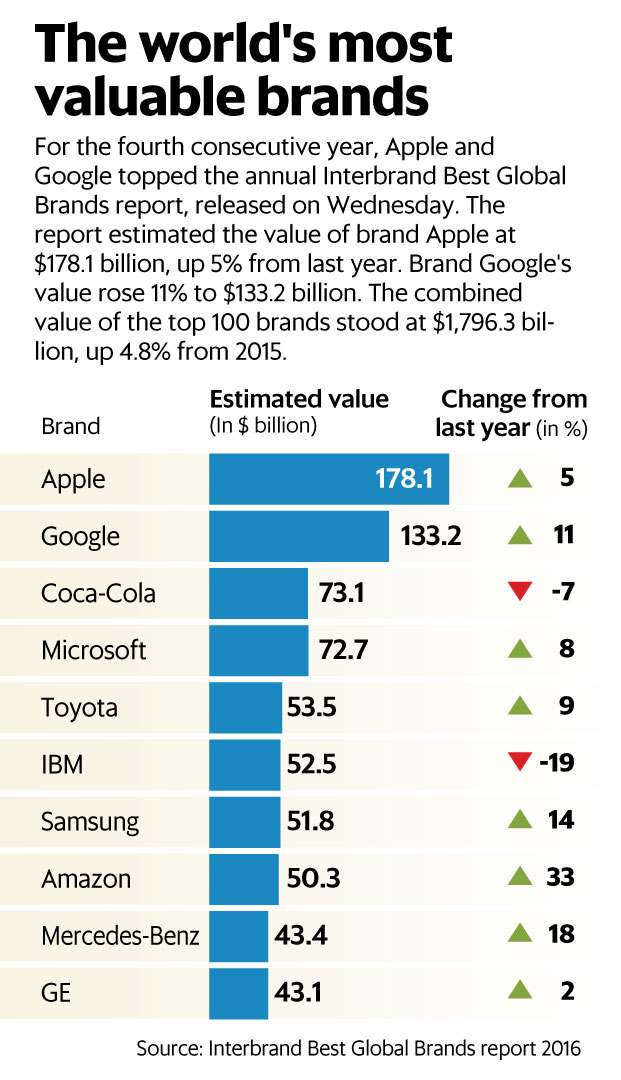
The report estimated the value of brand Apple at $178.1 billion, up 5% from last year. Value of brand Google was estimated at $133.2 billion, an increase of 11% from last year.

Beverages brand Coca-Cola stood third in the list at an estimated brand value of $73.1 billion, a 7% dip in brand value from last year. The top 10 brands in the list included Microsoft, Toyota, IBM, Samsung, Amazon, Mercedes-Benz and GE.

According to the list by the global brand consultancy, the world’s five top growing brands included Facebook, Amazon, LEGO, Nissan and Adobe. Brand Facebook witnessed the maximum increase in value at $32.5 billion, an increase of 48%, followed by Amazon.com (33%), LEGO (25%), Nissan (22%) and Adobe (21%), according to the report.

Google’s Self-Driving Cars Have More Driving Experience Than Any Human

Seven years ago, Google started a project to pursue a futuristic idea: Develop cars with software so advanced that it could take over all the driving for humans. Today, not only are Google’s fleet of self-driving cars navigating complex conditions in four U.S. cities, an entire industry has exploded with startups and automakers clamoring to develop the same technology.

“In 2009 we were just this crazy research project working on a science fiction idea,” Dmitri Dolgov, head of Google’s self-driving technology, told Fortune. “And look at where we are today. ”

Google self-driving cars have logged 2 million fully-autonomous miles on public roads, 90% of which were on city streets, the company announced Wednesday. Considering the hours spent on the road, Google’s cars now have the equivalent of 300 years of human driving experience.

Wednesday, 28 September 2016

Text analytics and beyondText analytics and beyond

The term “text analytics” encompasses a broad and heterogeneous group of technologies that can add metadata to unstructured content; identify components such as people, places and events; and convert information to structured form so it can be analyzed by business intelligence (BI) solutions. The technology may employ statistical, linguistic and machine learning approaches to extract meaningful information. It can be used in a wide range of business purposes, from fraud detection to sentiment analysis. The push is increasingly toward more sophisticated interpretation of unstructured content that goes beyond what is currently considered text analytics.

According to Forrester, more than 200 companies are providing text mining or text analytics products, so it is a crowded market. The participating software products offer a variety of approaches to extracting actionable information from content that is generally recognized as accounting for about 80 percent of enterprise content. Those software solutions are becoming more intelligent. Rather than focusing on keyword searches or statistical analyses alone, they are incorporating a deeper understanding of language through greater semantic analysis and machine learning. That trend is moving text analytics well past the traditional approaches into the realm of cognitive computing. 

Broadening the Scope of Mobile Security

Most enterprises, when addressing mobile security, focus on securing applications, such as the devices' operating systems, or preventing the installation of malware. But the cybersecurity experts at the National Institute of Standards and Technology say organizations should take a much broader approach to ensuring mobile security.

Referring to the need to address the risks posed by cellular networks and other elements of the mobile infrastructure, NIST Cybersecurity Engineer Joshua Franklin says: "There is this whole other side of a mobile device that has its own complex hardware, firmware, software and network protocols that need to be addressed." Franklin co-authored the recently released draft report, Assessing Threats to Mobile Devices & Infrastructure: the Mobile Threat Catalogue.

Monday, 26 September 2016

US Data Center Construction Update

September turned out to be a big month for big data center construction project announcements in the US. Facebook has finally decided to build in New Mexico, SAP is stepping into Colorado Springs in a big way, and data center providers Data Foundry and TierPoint are expanding their empires in Texas.

Here are the details:

New Mexico Scores $250M Facebook Data Center Build

After a tax-break war with the State of Utah, New Mexico has secured a commitment from Facebook to build its next data center in the Village of Los Lunas.

Thursday, 22 September 2016

Is Infor up for sale?


Over the last few weeks investment in ERP software has been increasing. The latest rumour (Source:Reuters) is that Infor is the latest in a line of companies sold or resold. It seems like private equity firms believe that there is money to be made in ERP software. According to Allied market Research the global ERP software market is set to grow 7.2% each year until 2020 when it will reach $41.69 billion.

The last year has seen several deals commence that should complete before the end of 2016. In December 2016 EQT made a bid for IFS, the Swedish ERP software company. While the initial bid saw only 84% snapped up, a revised offer was recently agreed with the hold out investor. This should see IFS taken private within a matter of weeks. Oracle made a bid for NetSuite, valuing the company at $9.3 billion in July. That purchase has since been delayed with one investor, T Rowe Price group saying that the bid is not high enough. In July this year Apax partners sold Epicor to KKR in a deal said to be worth $3.3 billion (Source: Bloomberg).

Wednesday, 21 September 2016

Official: Cloud computing is now mainstream

Cloud computing is so mainstream these days that maybe it should just be called “computing”. That’s what an IDC survey of 6,100 organisations in 31 countries, released today, indicates, with 68 per cent of respondents using public, private or hybrid cloud in their IT mix. This is a 60 per cent jump from 42 per cent of respondents doing cloud in 2015.

IDC reckons that just three per cent of the organisations have deploying cloud-optimised strategies resulting in "superior business outcomes".

And of this select “cloud-advanced” bunch, Ninety-five per cent have built a hybrid infrastructure that uses “multiple private and public clouds based on economics, location and governance policies”.